


Principle #1- Recognize the Importance of Bible Prophecy!
Many people fall into one of two ditches when it comes to Bible prophecy-
Ditch #1- There are those who go beyond what Scripture teaches and try to figure out what God has not revealed- they often err in the ditch of prophetic speculation. They speculate where Scripture is silent. This is seen by those who try and set dates for Christ’s return or who try to identify prophetic characters or details that the Bible doesn’t identify. A good rule of principle when it comes to Scripture is to speak with conviction where Scripture clearly speaks but to be silent where Scripture is silent!
Ditch #2- There are others who ignore Bible prophecy or minimize its importance. Some people avoid it because they see it as controversial, or divisive, or too difficult to understand. This is another ditch because of the fact that the Bible places a great emphasis on Bible prophecy- One-third of Scripture is prophecy.
When you ignore prophecy, you are ignoring one-third of the Bible. The Apostle Paul spoke much about prophecy. The Apostle John wrote one of the largest prophetic books of the Bible- Revelation. Jesus also spent a large amount of time dealing with prophecy.
Principle #2- Reject Date-Setting & Date-Setters!
“Beware of men who attempt to figure out the time of the Lord’s return. Such effort dishonors God’s Word, reproaches prophecy, and shipwrecks the faith of many of God’s children.” (P.B. Fitzwater)
We must beware of those who try to figure out what God hasn’t revealed!
Those who set dates for Christ’s return undermine Biblical teaching on Bible prophecy!
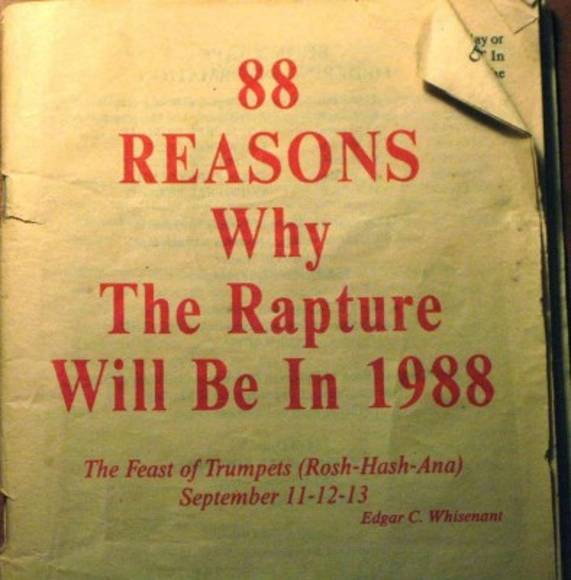 In 1988, a man by the name of Edgar Whisenant wrote a book entitled “88 Reasons Why Christ is Coming in 1988”. When 1988 came and went, he updated his book and entitled it “The Final Shout: Rapture Report 1989”. Edgar Whisenant may have been a sincere Christian who was eager for the Lord’s return but he could have saved himself from a whole lot of humiliation, from misleading others, and ultimately from hurting the testimony of Christ if he had simply done what the Bible says and accepted the fact that no man knows the timing of Christ’s return! Sadly, Whisenant is only one amongst many who have tried to predict the return of Christ but have failed.
When you a hear a supposed Bible teacher saying that Christ is coming back on a certain date: DON’T BELIEVE HIM!
Acts 1:7b- “…It is not for you to know the times or the seasons, which the Father hath put in his own power.”
Matthew 24:36- “But of that day and hour knoweth no man, no, not the angels of heaven, but my Father only.”
Principle #3- Recognize the Distinction Between the Rapture & Return of Christ!
When the Bible speaks of Second Coming of Christ, it speaks of two stages- the Rapture (when Christ comes for His saints and we meet Him in the clouds) & the Revelation of Christ (when Christ comes with His saints and He comes to bring judgment upon His enemies).
Understanding that there are two stages to the Second Coming helps us resolve the tension in Scripture which speaks of the imminency of Christ’s return (the fact that He could return at any moment) but also speaks of signs that precede His return.
Consider the following chart that shows how the Rapture & Return of Christ are not the same event:
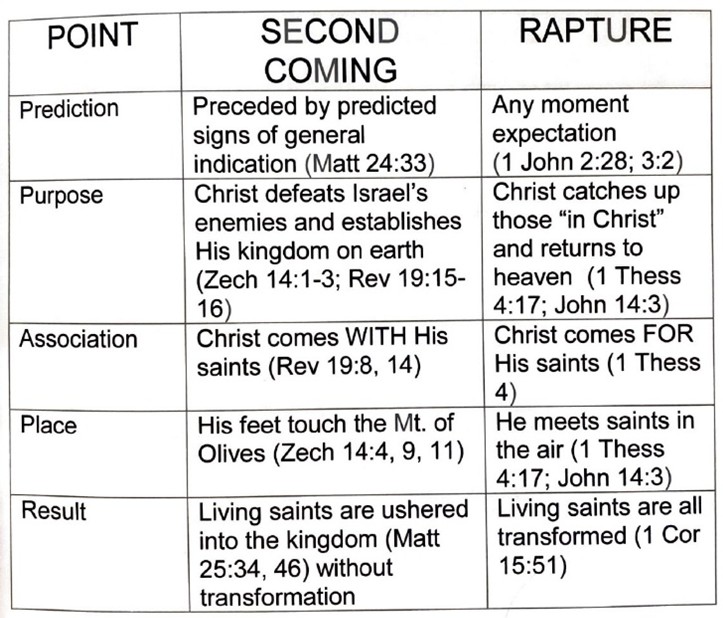
(Source: Eschatology– Gary E. Gilley)
Principle #4- Recognize God’s Distinct Plan for the Church and Israel!
The Church and Israel are distinct! They are not one and the same thing. God has a distinct plan for the Church & God has a distinct plan for Israel. The Church didn’t replace Israel. Instead, Scripture teaches that, although the nation of Israel is currently in a state of spiritual blindness, God has a future for Israel.
When the church is raptured, God will begin His dealings with Israel once again!
Something that is unique about the book of Revelation is that in Rev. 6-19 (which covers the Tribulation period) the church is not mentioned as being on earth. The reason is because the church is caught away to be with Christ before the Great Tribulation which is referred to as “the time of Jacob’s (a reference to Israel) trouble” (Jer. 30:7).
Principle #5- Rightly Divide the Word of Truth!
 There is much unscriptural teaching in the realm of Bible prophecy that comes from handling the Word of God in a careless manner. When we handle the Word of God, we must do so with great care and precision- making sure that we are not reading our ideas into Scripture, but instead, drawing out what God has said in Scripture.
Careless teaching in the realm of Bible prophecy has turned many people away from studying Bible prophecy. Sadly, its reputation has been smeared by teachers who have come up with all sorts of extrabiblical ideas & unbiblical doctrines in the name of prophecy. When we study the Bible, we must “rightly divide the word of truth” (2 Tim. 2:15).
Consider three fundamental principles that will help a person to “rightly divide” God’s Word:
-Interpret the Bible in a straightforward manner! Dr. David L. Cooper refers to this as the ‘Golden Rule of Interpretation’ and says: “When the plain sense of Scripture makes common sense, seek no other sense, but take every word at its primary literal meaning unless the facts of the immediate context clearly indicate otherwise.”
Another way of saying this is: “If the plain sense of Scripture makes common sense, seek no other sense, lest you end up with nonsense.” This method of interpretation is called the ‘Normal-Literal’ or ‘Grammatical-Historical’ method of Bible interpretation. This is a commonsense approach to handling God’s Word that uses standard rules of grammar to understand and interpret it. It is taking God’s Word at face value.
The opposite of this straightforward method of Bible interpretation is the allegorical method of interpreting the Bible- where instead of taking the plain sense of a passage, it is spiritualized to mean something else!
-Keep things in context! When interpreting a verse, read the verses before and after to make sure you are not taking a verse out of context. It is easy to make the Bible say what you want it to say by isolating verses, ignoring the context of a verse, and not using proper rules of interpretation. This is how false teachers handle the Word of God. But the faithful student of Scripture must not handle the Word in such a careless manner. To mishandle the Word is to ultimately misrepresent God.
Here are some helpful ways to keep a verse in context: 1) Never interpret a verse in isolation. Read the verses before it and read the verses after it. 2) Understand the theme of the book you are reading. 3) Try to understand the historical context of the passage. 4) Read the Bible carefully and slowly. Read a passage multiple times.
-Interpret the Bible with the Bible. The Bible is the best commentary on the Bible. When you study God’s Word, use Scripture to interpret Scripture. If you don’t understand a passage, search your Bible for other passages that will bring clarity to the verse you are studying.
This also involves interpreting difficult passages in light of clear passages. R.A Torrey once said, “Many do just the opposite…There will be a number of passages, the meaning of which is as plain as day. There will be another passage which is more or less obscure, and they will ignore all these perfectly plain passages and try to explain them away in the uncertain light of the obscure passage.”
Cults & false teachers often build their false doctrines on obscure & difficult passages while ignoring passages that are clear and easy to understand.
Conclusion
Keeping these principles in mind will help the student of the Bible better understand Bible prophecy and the whole of Scripture. May we seek to “rightly divide the word of truth” (2 Tim. 2:15).
2 Cor. 2:17- “For we are not as many, which corrupt the word of God: but as of sincerity, but as of God, in the sight of God speak we in Christ.”
~Pastor Aaron Francis


